
Hiring Intelligence: How a Connected Hiring Workflow Works
Learn what hiring intelligence means, how role context and candidate evidence connect across a hiring workflow, and how teams can make clearer, human-owned hiring decisions.
Hiring Intelligence11 min read
On this page
It's 4:30 on a Thursday, and the hiring debrief has just started.
The recruiter remembers a candidate who was candid about salary and clearly motivated. The engineering lead remembers someone who stalled on a system-design question. The hiring manager remembers a thoughtful story about owning a production outage.
Everyone is describing the same person. Nobody is sure they were hiring for the same role.
Then someone asks, “Did anyone write down what we were actually looking for?”
No one in that room necessarily did their job badly. Each interview may have been perfectly sound. What failed was the space between them: the role was defined once, interpreted in different ways, and the evidence ended up in notes, chat threads and memory.
That gap is where hiring intelligence matters.
Hiring intelligence is a team's ability to connect a hiring decision to the role it was made for, the evidence behind it and the people accountable for it - and, over time, learn carefully from how the process works.
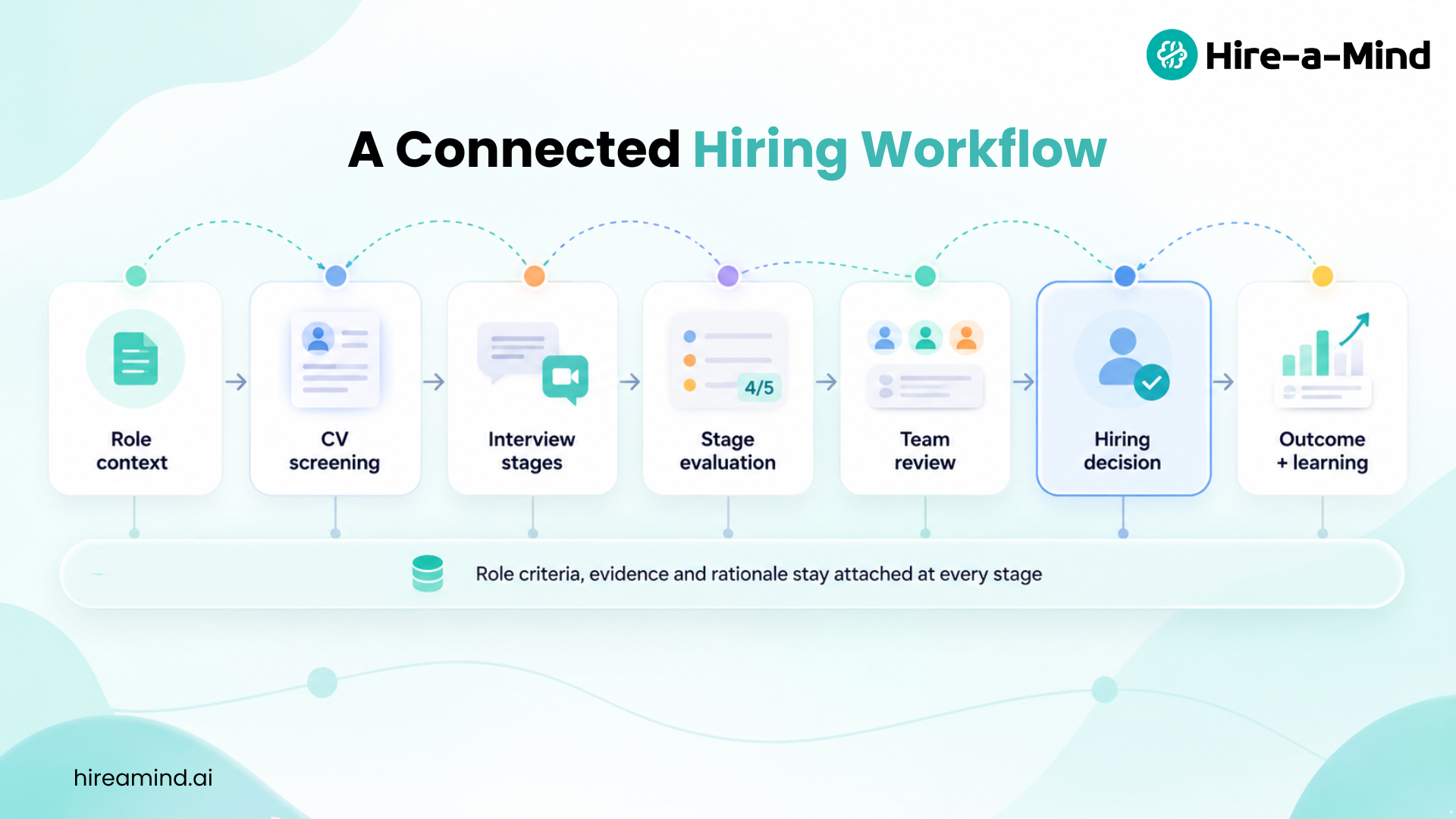
A connected hiring workflow is how a team puts that principle into practice. It does not mean every task must happen in one application. It means context and responsibility should survive as a candidate moves from one stage to the next.
This guide explains what that looks like, why disconnected handoffs create avoidable confusion, and how to start improving the process with one role.
What hiring intelligence actually involves
Hiring creates information at every stage: a job description, CVs, screening notes, interview questions, transcripts, scorecards, reviewer observations and a final decision. Most teams collect at least some of it. The harder part is keeping the pieces connected and useful.
Hiring intelligence rests on four foundations:
- Role context: What does success in this specific job require?
- Candidate evidence: What has the candidate actually demonstrated so far?
- Evaluation: How does that evidence relate to the agreed criteria, and what has not yet been established?
- Accountable decisions: Who reviewed the evidence, who made the decision and why?
These foundations work together. Role context should shape screening and interview questions. Evaluations should explain what the candidate demonstrated against the criteria. Reviewers should be able to distinguish evidence from interpretation and known information from unanswered questions. The person responsible for the decision should have enough context to make and explain the call.
This is different from recruitment automation. Automation moves tasks along: scheduling interviews, sending reminders or updating a status. Hiring intelligence concerns what the process reveals and whether the team can use that information.
A process can be heavily automated and still arrive at the debrief with little agreement about what was assessed.
For a closer look at the evaluation layer after an interview, read The End of Gut-Feeling Hiring: How AI-Driven Hiring Platforms Standardize Candidate Evaluation.
Why good tools do not automatically create a connected workflow
Most hiring teams already use several tools: an applicant tracking system (ATS), calendars, interview software, documents, spreadsheets and chat. The number of tools is not necessarily the problem. The problem is whether context survives each handoff.
Try these questions about your last hire:
- Did every stage work from the same definition of the role?
- Can the hiring manager see which evidence came from which stage?
- When a required skill was not tested, was that recorded—or did it quietly become “seems fine”?
- Did everyone know who decides whether a candidate moves forward?
- Could someone who was not in the interview explain why the final decision was made?
If the answers depend on searching chat history or asking, “Did anyone write that down?”, the tools may be working while the workflow is not.
Connected does not have to mean one application. An ATS can remain the system of record for candidate status while a specialist tool supports interview evaluation. What matters is that the role, candidate, assessment evidence, review and decision remain linked, with clear ownership of the next step.
The goal is fewer blind handoffs—not another dashboard for recruiters to maintain.
For practical guidance on connecting systems, see How to Connect an AI-Powered Hiring Platform to Your ATS Without Creating More Work.
How a connected hiring workflow works
Stages should vary by role, seniority and hiring context. A high-volume support role should not necessarily follow the same process as a senior security engineer. The underlying principles can remain consistent: define, screen, interview, evaluate, review and decide.
1. Define the role before judging candidates
Go beyond a list of qualifications. Write down the outcomes the person will own, the criteria that matter most and the evidence that would demonstrate them.
“Strong communicator” is difficult to assess consistently. “Explains a technical trade-off clearly, including its impact on customers and delivery” gives interviewers something more specific to look for.
That definition should inform the job description, screening criteria, interview questions and evaluation framework. Otherwise, drift is easy: the job description emphasizes backend architecture, the CV screen rewards years of experience, and the interview tests algorithm puzzles. Three stages, three versions of the role.
People define the hiring intent. AI may help structure and clarify it, but it should not invent the organization's requirements.
2. Give every stage a clear purpose
A recruiter screen might confirm essential requirements and candidate expectations. A technical interview might test debugging or system design. A hiring-manager conversation might explore ownership, prioritization or collaboration.
A stage earns its place by adding relevant evidence the team does not already have. If two rounds test the same competency in the same way, ask whether both are necessary - or whether the second should test a different depth or context.
For example, a technical-role process might include:
- Recruiter screen - confirm essential requirements and expectations.
- Technical interview - examine job-relevant technical capability.
- Hiring-manager interview - explore ownership, trade-offs and collaboration.
- Final discussion - resolve important remaining questions.
- Hiring decision - review the evidence and record the decision owner’s rationale.
This is an illustrative sequence, not a universal template. Do not add a round just because another stakeholder wants a turn.
3. Decide where AI helps and where people lead
AI can support structured tasks such as generating role-related questions, organizing interview responses, mapping evidence to agreed criteria or preparing an evaluation for review. Human interviewers contribute follow-up questions, context that a transcript may not capture, professional judgment and responsibility for the outcome.
The appropriate mix depends on what the stage is meant to establish. An AI-led first-round interview may help collect comparable responses to defined questions. A human conversation may be better suited to exploring a complex work scenario or leadership trade-off. Neither format removes the need to define what is being assessed.
The operating principle should be explicit: AI can structure information and support evaluation; people define the hiring intent and remain accountable for the employment decision.
Teams should decide in advance which actions require human review. If an organization chooses to use an automated advancement rule, it should be an explicit, documented configuration with clear ownership - not an assumed default.
4. Evaluate each stage against its purpose
After a stage, capture what was assessed, what the candidate demonstrated and what remains unknown. Use the agreed criteria rather than relying only on general impressions such as “great energy,” “not quite senior enough” or “seems like a fit.”
A useful evaluation connects a conclusion to evidence. If an interviewer says the candidate handled a production incident well, the notes should explain what the candidate did, which part of the response demonstrated the relevant competency and what the interviewer could not verify.
Not every assessment will produce a clear answer. That is useful information too. If the interview did not test a required skill, record that the evidence is missing rather than treating the absence of evidence as proof of weakness.
For more on how evidence-backed evaluations work, see The End of Gut-Feeling Hiring.
5. Name an owner for every consequential step
Who reviews the evaluation? Who decides whether the candidate advances? Who resolves conflicting feedback? Who makes the final hiring decision?
The answers vary by organization, but they should be agreed before a disagreement—not during one. A recruiter may coordinate the process without owning the technical pass/fail decision. A hiring manager may own the final call while relying on specialist interviewers for evidence.
“Everyone can weigh in” is not the same as “everyone knows who decides.”
Clear ownership also helps prevent candidates from getting stuck between stages while the team waits for someone else to act.
6. Bring feedback together without flattening differences
Interviewers see different parts of a candidate, so their views will not always agree. The workflow should preserve each observation with its stage and criteria, then make the differences available for review.
A cumulative candidate view should not be a blind average of scores. A technical assessment and a stakeholder conversation may test different capabilities. Their relative importance depends on the role and the evaluation framework.
The aim is not to hide disagreement inside a single number. It is to help the decision-maker understand what the team knows, where evidence conflicts and what remains unresolved.
A useful review asks:
- What evidence supports the candidate’s strengths?
- Which role requirements remain unverified?
- Where do reviewers disagree, and what might explain the difference?
- Is another assessment genuinely needed to resolve an important uncertainty?
- Who owns the next decision?
Disagreement is not automatically a process failure. Unexamined disagreement is the problem.
7. Record the decision and the reason
A hiring decision should be more than a status change. The team should be able to record who made the decision and which job-related evidence informed it.
This does not require a long essay. A concise rationale tied to the agreed criteria is more useful than “the panel liked her.” Reviewers should be able to question, correct or override AI-generated findings when the evidence warrants it.
AI-generated scores and recommendations are inputs for review, not substitutes for accountability. The organization remains responsible for its hiring decision.
The same Thursday, with a connected workflow
Return to the debrief at the beginning of this article.
This time, the role criteria were written down before the first interview, and each stage had a stated purpose. Each evaluation includes its supporting evidence and identifies what was not tested.
The recruiter's observation about motivation is linked to the criterion it supports. The engineer's concern about system design is recorded as an area that needs further validation, not an unexplained verdict. The hiring manager's production-outage example is linked to the question that prompted it.
The room can now focus on the real question: is a focused follow-up about system design worth another conversation, or is the available evidence sufficient?
The designated decision owner makes the call and records the reasoning.
The workflow did not make the decision for the team. It made the disagreement specific enough to resolve.
From decisions to learning
Over time, a team may want to understand where candidates drop out, which stages create delays, where reviewers regularly disagree and whether the process is testing the capabilities that matter for the role.
That is a potential source of process improvement, but it needs careful interpretation. Small samples can mislead, hindsight can distort how a decision is remembered, and an outcome does not prove that the process was sound - or unsound - on its own.
Three principles matter:
- Use outcome information to review the process, not to claim certainty. Look for questions worth investigating rather than treating limited data as proof.
- Do not automatically reuse past candidate scores. Each person should be evaluated against the requirements and evidence relevant to the current role.
- Apply appropriate governance. Candidate information and hiring records should be available only to people with a legitimate need and handled according to the organization’s policies and applicable requirements.
Hiring intelligence is not a prediction engine that software delivers on its own. It is a capability teams build by maintaining useful records, reviewing their process and making deliberate changes.
How to start: one role, seven steps
You do not need to redesign every role at once. Pick one recurring role and walk the process from application to decision.
- Map the stages that actually happen. Include informal calls and last-minute stakeholder reviews.
- Give each stage one purpose. State the evidence it should produce and remove avoidable duplication.
- Write the role criteria before interviewing. Describe what good evidence looks like.
- Name the decision owners. Make clear who reviews, who advances and who makes the final call.
- Set the AI–human boundary. Specify what AI may prepare, where human review is required and which actions remain human-owned.
- Keep feedback connected. Attach evidence to the candidate, role criteria and stage.
- Review the process after the hire. Identify where handoffs failed and what you will change next time.
Then test the workflow with the people who use it. Ask a recruiter, an interviewer and a hiring manager separately to explain what happens after each stage. If you get three different answers, you have found a practical place to start.
Where Hire-a-Mind fits
Hire-a-Mind focuses on the information created around interviews: helping teams define role criteria, screen CVs against those criteria, run AI interviews and turn interview information into structured evaluations for human review.
Those capabilities support important parts of a hiring workflow by making role requirements and interview evidence easier to examine. The broader idea of hiring intelligence is the operating principle: connect what the role requires, what the candidate has demonstrated and what the hiring team reviews before making a decision.
This article does not assume that every organization’s multi-stage process, cumulative candidate view or advancement rules are automatically configured in the current product. Product capabilities should be confirmed against the live version before publication.
AI structures the information. Your team defines what matters and makes the hiring decision.
Explore Hire-a-Mind.
The point is a better-supported decision
The goal was never a smarter-sounding debrief. It was to walk into the room with a shared record instead of four memories, leave knowing who decided and why, and retain useful lessons for the next hire.
Hiring intelligence is not another name for automation, and a connected workflow is not simply a longer list of interview stages. It is the discipline of carrying role context, evidence, evaluation and responsibility from one step to the next.
When that connection is missing, teams spend time reconstructing what happened. When it is present, they can focus on the questions that matter: What has the candidate demonstrated? What do we still need to know? Who is responsible for the decision?
Hire based on evidence, not hunches - and keep people accountable for the call.
Frequently asked questions
- What is hiring intelligence?
- Hiring intelligence is a team's ability to connect role context, candidate evidence, evaluation and accountable decisions across the hiring process - and to learn carefully from how the process works.
- How is hiring intelligence different from recruitment automation?
- Recruitment automation executes tasks such as scheduling, reminders and status updates. Hiring intelligence focuses on whether the information produced at each stage is connected, useful and available to the people responsible for the next decision. The two can work together.
- Do we need to replace our ATS to build a connected hiring workflow?
- Not necessarily. An ATS can remain the system of record for candidates and hiring stages while other tools support specific tasks, such as interview evaluation. The important question is whether context, evidence and decision ownership survive the handoffs.
- Does AI make the final hiring decision?
- It should not be treated as the accountable decision-maker. AI can help organize information and prepare findings for review, but people define the hiring criteria, examine the evidence and remain responsible for the employment decision.
- Where should a small team start?
- Start with one recurring role. Map the stages that really happen, give each stage a clear purpose, define criteria before interviewing and name the person responsible for each decision. Review the workflow after the hire and improve one problem at a time.
- Hiring Intelligence
- Hiring Workflow
- AI in Hiring
- Hiring Workflow
- Hire-a-Mind
- Evidence-Based Hiring
- Recruitment Technology
Hire based on evidence, not hunches.
Hire-a-Mind connects role definition, screening, interviews and evaluation around one hiring standard.
Keep reading
All articles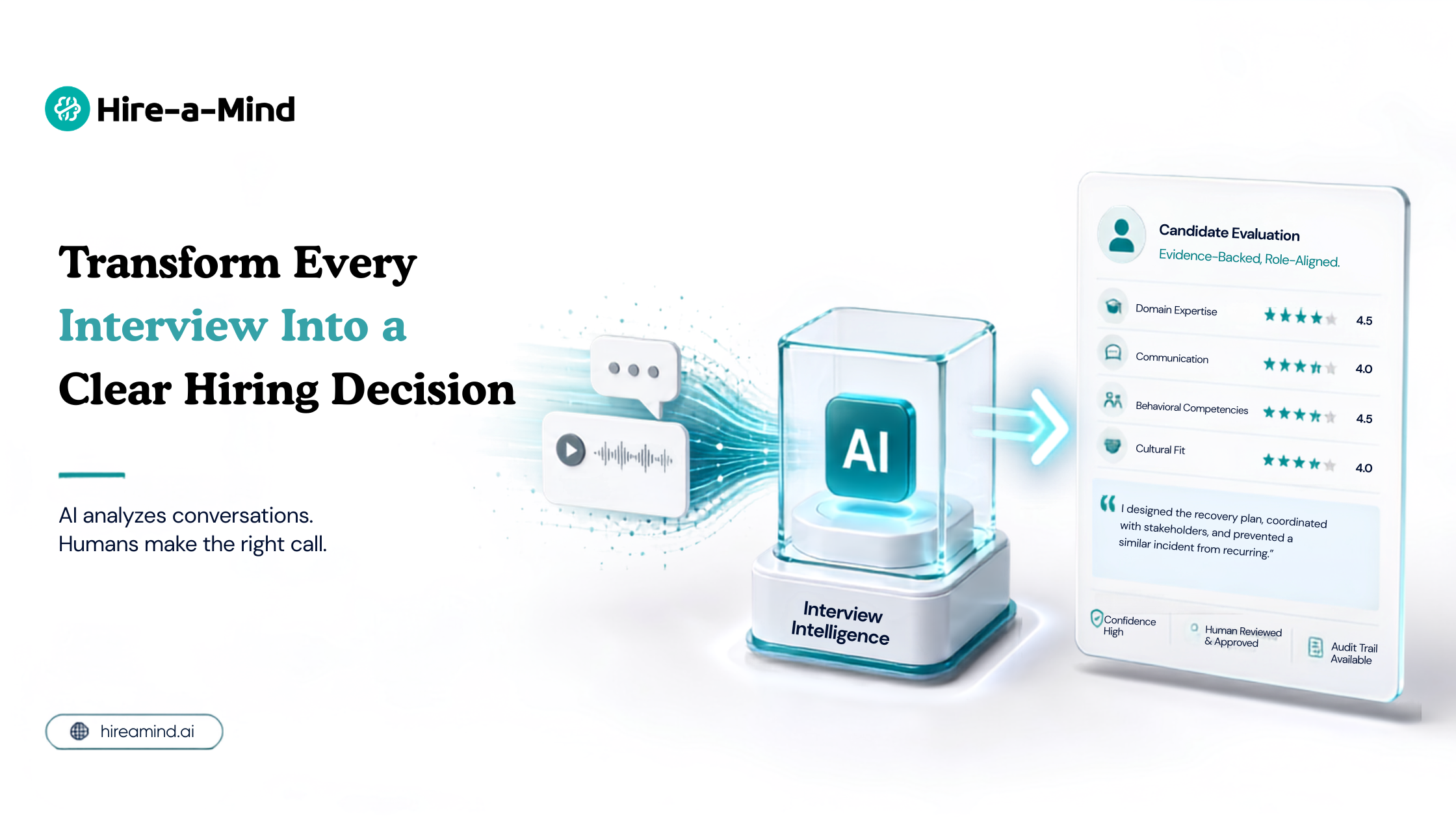
Candidate Evaluation
The End of Gut-Feeling Hiring: How AI-Driven Hiring Platforms Standardize Candidate Evaluation
Discover how AI interview intelligence replaces memory-led hiring with structured evidence, consistent evaluation, and human-reviewed candidate decisions.
Hiring Operations
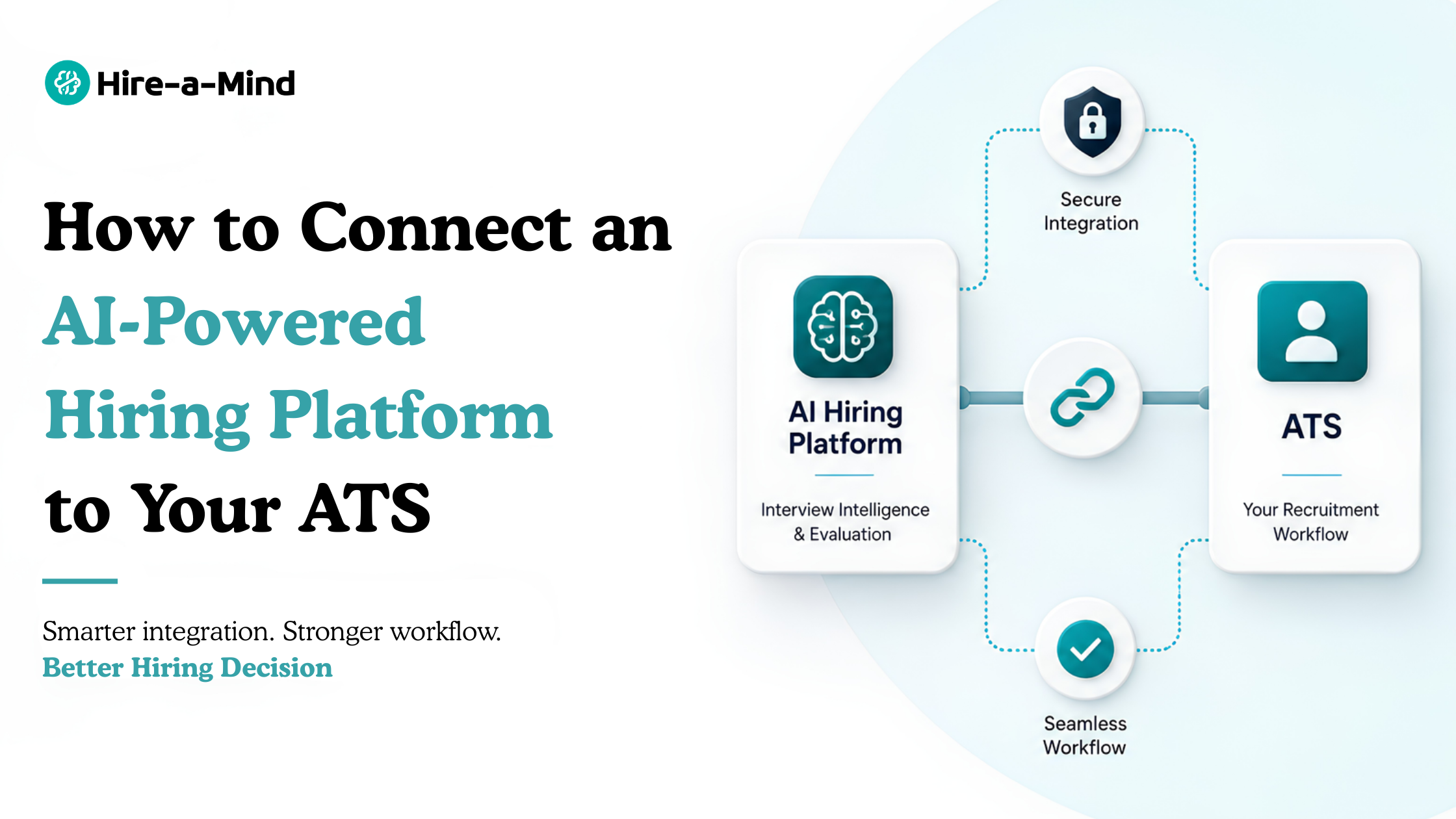
How to Connect an AI-Powered Hiring Platform to Your ATS Without Creating More Work
Learn how to integrate an AI hiring platform with your ATS without duplicate work, disconnected workflows, security risks, or another recruiter dashboard.
Interview Intelligence
The Invisible Assistant: Mastering the Art of Human-First AI Recruitment
Discover how invisible AI assistants help recruiters eliminate administrative work, improve candidate experience, and keep hiring human-first without replacing recruiter judgment.